A Pending Project  - Mandolinetto

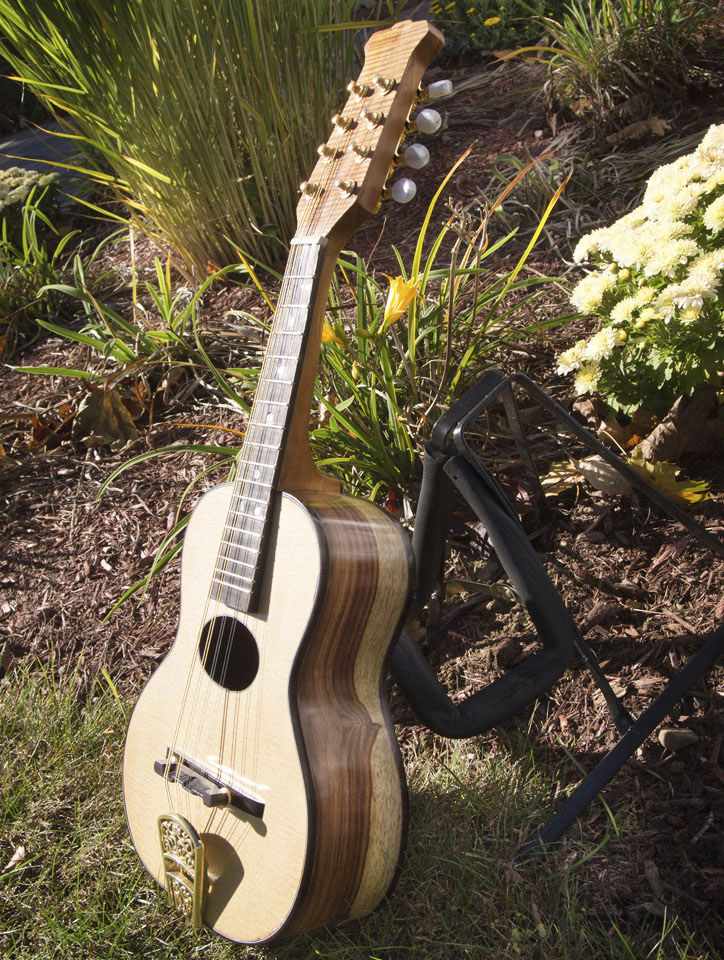
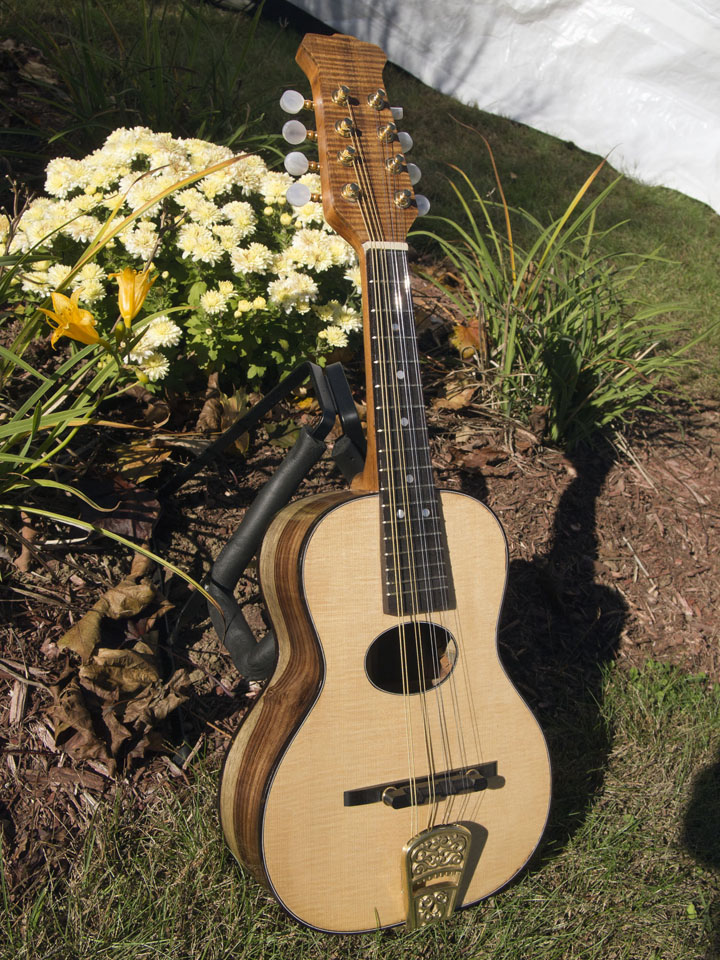
Mandolinetto - Front

Mandolinetto - Front

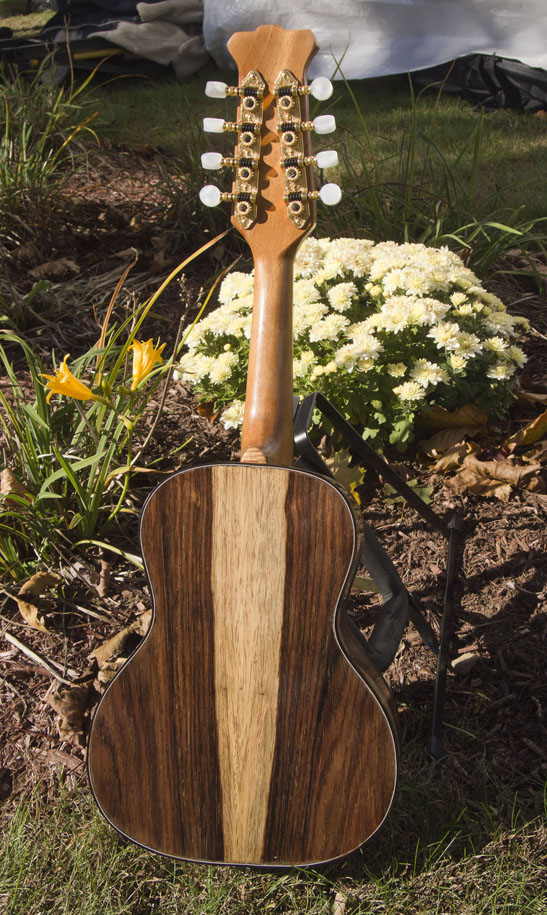
Mandolinetto - Back

Mandolinetto - Back

Mandolinetto - Side

Mandolinetto - Side

Mandolinetto - 3/4

Mandolinetto - 3/4

Hardware

Hardware

Here’s something I’m planning to build sometime within the next year or so. This looks suspiciously like a ukulele, but it isn’t. It’s strung like a mandolin - eight steel strings in pairs. I saw one of these for the first time -- in fact the only time -- one  night watching Devin Champlin of  the Gallus Brothers backing. Maria Muldaur. He was kind enough to let me take a good look at it -- the label inside said “Vernon.” and told me these were quite popular about 100 years ago.

So I posted a query on the Mandolin Cafe asking what these were and if anyone could give me some measurements and guidance to the top bracing pattern so I could build one. Within a couple of days I learned from helpful posters that these are called Mandolinettos and back in the day (1900 to 1920 or so) these sold,for as little as $6 to $10 at the likes of Sears and Roebuck.

What’s more, I got a private email from a great guy named Eddie Sheehey who said he’d just bought one and hadn’t yet restored it. He offered to send it to me so I could take measurements and draw plans. I took him up on his offer and he shipped it to me and let me keep it for a couple of months, during which I cleaned it up a bit, took careful measurements, and made the drawings below. So thanks to the kindness of strangers I now have the details I need to build a modern version of one of these. Click the thumbnails above for a good look. Check out especially the grain and pattern of the Brazilian Rosewood. Needless to say. the one I build won’t be Brazilian.-- but I’ve got some nice beeswing mahogany that should do. Also I’ll add an adjustable truss rod. All of these old ones need neck resets. Those eight steel strings take a toll over a hundred years, even on a short neck like this. 

Here’s the set of plans I drew from the Mandolinetto Eddie Sheehey loaned me.  Click the image for a larger view. If anyone is inclined to build one of these, email me and I’ll send you a copy of the plans.

The headstock measurements and peghole spacing are true to the original instrument. However, there is a need for modification to accommodate modern mandolin tuning machines, which have the tuning post below the worm gear. This instrument and most mandolins of its vintage had the tuning post above the worm gear. You can’t simply install modern tuners upside down because they would work in reverse of every other stringed instrument -- you’d end up loosening when you meant to tighten, which would quickly drive you nuts.

Because of the reversed relationship of peg to worm gear, the whole tuning assembly of modern style tuners shifts north by about 1/2 inch, causing the baseplate to extend beyond the top of the headstock--leaving brass sticking out into empty space beyond the wood..

Mandolinetto_Plans_Thumb


OK, so we’ve identified the problem; what’s the solution? I can think of three:

1. Find a source of old-style reverse tuners. I haven’t had any luck -- they are available for F-style headstocks, but I haven’t been able to find any for A-style headstocks. I’ve seen a few that claim to be reverse A-style tuners, but they aren’t. The key thing to look for is the slant of the worm gear. The  slant of the grooves needs to be opposite the slant of modern tuners.

2. You could make the headstock a bit longer so the brass baseplate of modern tuners no longer extends beyond the top of the headstock.  I might take this approach when I build mine. The downside is it’s already a big headstock and making it any bigger might make it look like a snow shovel. Also, if it s much longer it may be hard to  find a ukulele case that fits.

3. You could shift the post holes south (toward the nut). I’m also thinking of taking this approach. The problem that then needs fixing is the bunching up of strings from the nut to the tuning posts -- e.g., the second G string will rub against the post of the first G string. A solution for this would be to change the headstock to a snake-head shape, (like on a snakehead Gibson mandolin or a modern Seagull Guitar).


Gibson Snakehead Mandolin Headstock

Gibson Snakehead Mandolin Headstock